From collection Creating Acadia National Park: The George B. Dorr Research Archive of Ronald H. Epp


Page 1
Page 2
Page 3
Page 4
Page 5
Search
results in pages
[Series IX] The Mountain Naming Controversy (Woodlawn Museum 2 #3 2005)
"The Mountain Namias Contro
-
versy. "Woodlown Meeseum
2,=3(2005):
WOODLAWN
M IUSEUM
The Black House
MAINE'S
PREMIER
HISTORIC
ESTATE
Summer 2005
A Property of the Hancock County Trustees of Public Reservations
vol. 2 no. 3
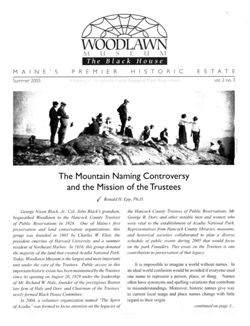
The Mountain Naming Controversy
and the Mission of the Trustees
Ronald H. Epp, Ph.D.
George Nixon Black, Jr., Col. John Black's grandson,
the Hancock County Trustees of Public Reservations, Mr.
bequeathed Woodlawn to the Hancock County Trustees
George B. Dorr, and other notable men and women who
of Public Reservations in 1928. One of Maine's first
were vital to the establishment of Acadia National Park.
preservation and land conservation organizations, this
Representatives from Hancock County libraries, museums,
group was founded in 1901 by Charles W. Eliot, the
and historical societies collaborated to plan a diverse
president emeritus of Harvard University and a summer
schedule of public events during 2005 that would focus
resident of Northeast Harbor. In 1916, this group donated
on the park Founders. This essay on the Trustees is one
the majority of the land that created Acadia National Park.
contribution to preservation of that legacy.
Today, Woodlawn Museum is the largest and most important
unit under the care of the Trustees. Public access to this
It is impossible to imagine a world without names. In
important historic estate has been maintained by the Trustees
an ideal world confusion would be avoided if everyone used
since its opening on August 20, 1929 under the leadership
one name to represent a person, place, or thing. Names
of Mr. Richard W. Hale, founder of the prestigious Boston
often have synonyms and spelling variations that contribute
law firm of Hale and Dorr, and Chairman of the Trustees'
to misunderstandings. Moreover, historic names give way
newly formed Black House Committee.
to current local usage and place names change with little
In 2004, a volunteer organization named "The Spirit
regard to their origin.
of Acadia" was formed to focus attention on the legacies of
continued on page 3...
Mountain Naming (continued from page 1)
There is a long-standing 'democratic' conviction in
America that everyone has an equal right to bestow-and
defend-a geographic name. To counter nomenclature
anarchy and confusion relating to geographic names, in the
late 19th century the United States Board on Geographic
Names (Board) established nomenclature criteria and
rendered decisions that were binding for Federal agencies.
The Woodlawn Archives provide rich insights into a
naming controversy that surfaced on the heels of the 1928
donation of the Woodlawn estate to the Hancock County
Trustees of Public Reservations (Trustees). The central
figure in this controversy was George Bucknam Dorr
(1853-1944), one of the eight Trustee Incorporators and its
First Vice President for more than four decades. Mr. Dorr's
energetic stewardship over three decades was responsible
for most Trustee donations and the eventual gifting of these
properties to the federal government, establishing the Sieur
de Monts National Monument in 1916.
In 1917, as Monument Custodian, Mr. Dorr proposed
well-developed arguments for changing the names of nearly
a dozen natural objects within Monument boundaries to
the National Park Service (NPS). Receiving the necessary
NPS endorsements, he made formal application to the
Board on September 15, 1918 and within two weeks
new nomenclature was authorized. While the motives for
reference." As a new federal administrator, Dorr was also
mountain renamings were complex, Dorr argued in part that
trying to conform to the Board principle of long standing
the conventional names (e.g., Brown, Dog, Dry, Green etc.)
usage, yet as a scholar Dorr was compelled to locate historic
were undistinguished. As a result, nearly half the mountains
precedent for the conventional names. Where the historical
that form the Mount Desert Range were renamed Acadia,
roots were shallow, Dorr saw an opportunity to develop
Bernard, Cadillac, Champlain, Huguenot Head, Mansell,
alternative historical arguments that emphasized the role of
and Norumbega.
Native American and French historical associations. In this
Following the 1919 elevation of the Monument to
process he pressed for a more ancient lineage than what was
national park status (Lafayette National Park), other
customary on Mount Desert Island.
geographic name changes were proposed and by 1929
Boston attorney and Trustee Richard W. Hale initiated
approvals were secured to rename ten of fourteen
a defense of the traditional mountain names more than a
mountains-and island maps reflected these changes.
decade after the 1918 approvals. His January 2, 1931 letter
For Mr. Dorr, name selection resulted from extensive
to the editor of the Bar Harbor Times stated that at the August
study. The National Archives, Rockefeller Archive Center,
28, 1930 annual meeting of the HCTPR he entered a motion
the Board Archives, and the Sawtelle Research Center
to fellow Trustees that at the next annual meeting they
contain Dorr's arguments. He recognized that early
declare themselves in favor of the "well known names." An
settlers gave "excellent descriptive names" to the seacoast
informal Trustees poll, via postcard, revealed that 28 of 36
and harbored waters where names like Egg Rock and
favored the names in use before the Board approvals. Hale
Otter Creek suggest their own interesting ancestry. But
asked the Times to poll its readers. Over the next several
"mountains and paths, woods and lakes, must all have
weeks ballots were cast and the tally was overwhelming:
names for the sake of distinction and as points of visitor
150 for the old names, three for the new. Letters to the Times
3
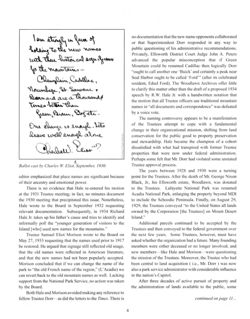
I am strongly in law of
no documentation that the new name opponents collaborated
or that Superintendent Dorr responded in any way to
holding to the new names
public questioning of his administrative recommendations.
Privately, Ellsworth District Court Judge John A. Peters
with there historical sign Seconum
advanced the popular misconception that if Green
for the maintains-
Mountain could be renamed Cadillac then logically Dorr
"ought to call another one 'Buick' and certainly a peak near
Champlain, Cadellae,
Seal Harbor ought to be called 'Ford''' (after its celebrated
resident, Edsel Ford). The Woodlawn Archives offer little
Noumhega, St. Sarveur
to clarify this matter other than the draft of a proposed 1934
Bernard are a thousand
speech by R.W. Hale Jr. with a handwritten notation that
the motion that all Trustee officers use traditional mountain
Times better than
names in "all documents and correspondence" was defeated
Green, Brown, Bosete.
by a voice vote.
The naming controversy appears to be a manifestation
One change is enough. Leto
of the Trustees attempt to cope with a fundamental
change in their organizational mission, shifting from land
leave well enough alone
conservation for the public good to property preservation
and stewardship. Hale became the champion of a cohort
Charleen
dissatisfied with what had transpired with former Trustee
properties that were now under federal administration.
Perhaps some felt that Mr. Dorr had violated some unstated
2
Ballot cast by Charles W. Eliot, September, 1930.
Trustee approval process.
The years between 1928 and 1930 were a turning
editor emphasized that place names are significant because
point for the Trustees. After the death of Mr. George Nixon
of their ancestry and emotional power.
Black, Jr., his Ellsworth estate, Woodlawn, was donated
There is no evidence that Hale re-entered his motion
to the Trustees. Lafayette National Park was renamed
at the 1931 Trustee meeting; in fact, no minutes document
Acadia National Park, enlarging the property beyond MDI
the 1930 meeting that precipitated this issue. Nonetheless,
to include the Schoodic Peninsula. Finally, on August 29,
Hale wrote to the Board in September 1932 requesting
1929, the Trustees conveyed "to the United States all lands
relevant documentation. Subsequently, in 1934 Richard
owned by the Corporation [the Trustees] on Mount Desert
Hale Jr. takes up his father's cause and tries to identify and
Island."
informally poll the "younger generation of visitors to the
Additional parcels continued to be accepted by the
Island [who] used new names for the mountains."
Trustees and then conveyed to the federal government over
Trustee Samuel Eliot Morison wrote to the Board on
the next few years. Some Trustees, however, must have
May 27, 1933 requesting that the names used prior to 1917
asked whether the organization had a future. Many founding
be restored. He argued that signage still reflected old usage,
members were either deceased or no longer involved, and
that the old names were reflected in American literature,
new members-like Hale and Morison-were questioning
and that the new names had not been popularly accepted.
the mission of the Trustees. Moreover, the Trustee who had
Morison concluded that if we can change the name of the
been central to land acquisition ( i.e., Mr. Dorr ) was now
park to "the old French name of the region," (L'Acadie) we
also a park service administrator with considerable influence
can revert back to the old mountain names as well. Lacking
in the nation's Capitol.
support from the National Park Service, no action was taken
After three decades of active pursuit of property and
by the Board.
the administration of lands available to the public, some
Both Hale and Morison avoided making any reference to
fellow Trustee Dorr-as did the letters to the Times. There is
continued on page 11
4
Mountain Naming (continued from page 4)
members must have wondered-as John D. Rockefeller, Jr.
by ownership by cooperation, and in part by helping to
proposed-whether the Trustees should disband now that
form public opinion."
their mission had been realized. Instead, throughout the
There is no indication of any residual interest in
Depression Era, without any formal declaration, the Trustees
mountain naming but there is recognition that future gifts
shifted from land acquisition for public recreation to the
"might favor national and remote control" [i.e., federal and
single-minded management of the Woodlawn estate. Few
state management]. President Morris rather nicely set the
records of Trustee meetings during the period 1931-1939
stage for the challenge that some see the Trustees facing
survive, and it is plausible that they entered a period of near
today. Morris thought strategically, focusing attention on the
dormancy while the Black House (Woodlawn) Committee
need for a new vision, a new organizational structure, and
took center stage.
the necessity of Trustees' commitments more far-reaching
In a Trustee circular letter dated September 21,
than routine financial support.
1940, the issue of the future of the Trustees was raised
by President Dave Hennen Morris. He proposed that
Ronald H. Epp, Ph.D. is writing a biography of
"we keep the corporation not only technically, but also
George Bucknam Dorr, the first such effort to document
substantially, alive and vigorous and endeavor to serve the
his historical significance as a conservationist. Dr. Epp is
community in the field of owning property for public access
currently Director of the University Library, Southern New
and enjoyment." Not only does he advocate "luxurious"
Hampshire University.
rather than "grudging support" for Woodlawn, but he
broadens the traditional Trustee goal to emphasize "public
enjoyment of [Hancock County] natural resources in part
Preserve Maine's Premier Historic Estate - Become a Member Today!
Yearly basic membership benefits include: Free admission per member per year, a subscription to the award-winning Woodlawn newsletter, a 10% discount in the Museum
Store for purchases over $10.00, notification of the annual members reception, a Woodlawn Museum window decal, and notification of special events as designated by the
Museum. Additional benefits are specified below:
Basic Membership Levels
I enclose $
for Membership Dues at the
Level
Student $5: All basic membership benefits for a student in grades K-12.
Dr.
Mr.
Mrs.
Ms.
Miss
Individual $35: All basic membership benefits for one person.
Name(s)
Street
Household $50: Individual membership benefits for two adults and household
members under 18, a 25% discount on designated events for which there is a
City
State
Zip
Phone
fee, and 4 free tickets for Black House tours during the season.
I would like to charge my membership on
Visa
Mastercard
Supporter $125: Household level membership benefits plus 8 free tickets for
Card Number
Expiration Date
/
/
Black House tours during the season.
Card Holder's Signature
Sustaining Membership Levels
In addition, I would also like to make donation to the Museum's Annual Fund in the
Sponsor $250: Supporter level membership benefits plus 10 free tickets for
Black House tours during the season and a 20% discount in the Museum Store.
amount of $25
$50
$75
$100
Other
Patron $500: All Sponsor level membership benefits plus a behind-the-scenes
Membership dues and other contributions are tax deductible as provided by law.
tour with curatorial staff arranged by appointment.
Benefactor $1,000: Patron level membership benefits plus a special tour and
Please mail completed form with your dues to:
reception with the Executive Director for 4 adults arranged by appointment.
President's Club $2,500: Benefactor level membership benefits plus an
Membership, Woodlawn Museum
invitation to the President's Dinner with the Executive Director and members
WOODLAWN
P.O. Box 1478, Ellsworth, Maine 04605
of the Board of Trustees. The President's Dinner will occur in the autumn of
M S E u M
each year and will be served at the Museum.
The Black House
Please make checks payable to Woodlawn Museum
11
Viewer Controls
Toggle Page Navigator
P
Toggle Hotspots
H
Toggle Readerview
V
Toggle Search Bar
S
Toggle Viewer Info
I
Toggle Metadata
M
Zoom-In
+
Zoom-Out
-
Re-Center Document
Previous Page
←
Next Page
→
[Series IX] The Mountain Naming Controversy (Woodlawn Museum 2 #3 2005)
| Page | Type | Title | Date | Source | Other notes |
| 2-5 | Journal Article | The Mountain Naming Controversy and the Mission of the Trustees / Ronald Epp | Summer 2005 | Woodlawn Museum: The Black House: Vol 2 #3 | - |
Details
2005